
§ 01What a watch case is
The case is the housing that holds and protects the movement, dial, and hands. It is the structural heart of the watch: it defines the shape and size, carries the crystal and crown, seals out water and dust, and provides the points where the strap attaches. Almost every other decision — water resistance, materials, finishing — is built on the case.
§ 02The parts of a case
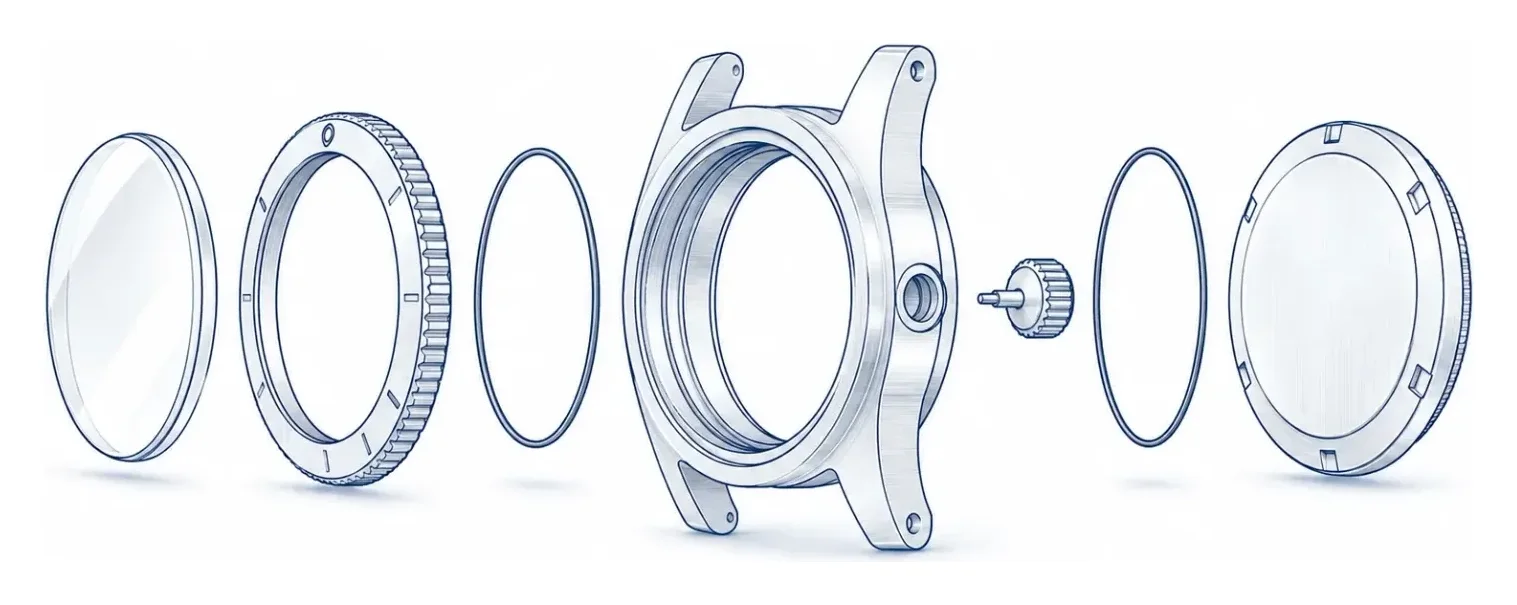
| Part | What it does |
|---|---|
| Case middle | Central body that holds the movement |
| Bezel | Ring around the crystal — fixed or rotating |
| Caseback | Seals the rear; snap, screw, or display |
| Lugs | Arms that hold the strap or bracelet |
| Crown | Knob to wind and set; screw-down for water resistance |
Each part is its own small engineering decision. The bezel can be a plain frame or a rotating timer — the differences are covered in the bezel guide. The caseback’s attachment sets the water-resistance ceiling for the whole watch, as explained in the caseback guide. The lugs decide the strap width and half of how the watch wears; drilled lugs (with a through-hole for the spring-bar tool) are a small detail strap-swappers love.
Together these parts, plus their gaskets, form the sealed enclosure that protects the movement.
§ 03Crystal and crown
The crystal
The transparent cover over the dial comes in three materials. Sapphire — synthetic corundum at roughly 2,000 HV — is effectively scratch-proof in normal life and is the expected standard from the mid-market up; an anti-reflective coating on its underside removes its one weakness, glare. Mineral glass is hardened glass: perfectly serviceable, much cheaper, but it collects scratches over years. Acrylic survives on heritage reissues for its warm, domed look and shrugs off shattering, though it scuffs (and polishes back) easily. The crystal seats against its own gasket and is one of the three seal points — with the caseback and crown — that decide real water resistance.
The crown
A standard push-pull crown seals on internal gaskets and suits everyday ratings. A screw-down crown threads onto a tube machined into the case middle, mechanically compressing its seals — it is a practical requirement beyond 10 ATM and standard on dive builds. Signing the crown with a logo is a small tooling cost that finishes the case’s branding story.
§ 04Case materials
The material sets durability, weight, skin safety, and cost. The mainstream choices run from budget alloy to premium titanium.
- Zinc alloy — cheapest, die-cast, but soft and plating-dependent; for fashion pieces.
- 316L stainless steel — the quality standard: corrosion-resistant, hypoallergenic, substantial.
- 904L / titanium — premium; titanium is ~40% lighter and equally skin-safe.
- Bronze / wood — character materials for niches: bronze patinas, wood is a category of its own.
For the full comparison — including why 316L became the standard and what alloy really trades away — see alloy vs stainless steel watches.
§ 05Size and proportions
Case size is more than the diameter quoted on the dial. Three measurements decide how a watch wears: diameter (across the case), thickness (top to bottom), and lug-to-lug (the distance between the strap arms, which sets how far it spans the wrist). A 40mm watch with long lugs can wear larger than a 42mm with short ones.
| Measurement | Typical range | Rule of thumb |
|---|---|---|
| Diameter | 36–44 mm | 38–42 mm is the versatile middle |
| Thickness | 8–15 mm | <10 dress · 11–13 sport · 13+ dive |
| Lug-to-lug | 42–52 mm | Should not overhang the wrist |
Thickness is the number spec sheets hide and wrists notice. It is driven from inside out: movement height + dial + hands clearance + crystal. A slim automatic (like a Miyota 9015 at 3.9 mm) is what makes a slim case possible — the case cannot be thinner than what it contains.
§ 06Specifying a custom case
For a custom build, the case is where you make your watch your own: the shape (round, cushion, tonneau), the size, the material, the finish, the lug style, the crown, and the caseback type. Each choice shifts the look, the water resistance, and the cost — a fully custom case shape means new tooling, while modifying a proven case geometry gets a distinctive result at a fraction of the tooling budget. Which route fits depends on your quantity and price target; both are quoted side by side in our OEM cost guide.
We machine and finish cases in-house. Send a reference or a sketch and we will spec the case — and quote the tooling and per-unit cost — within 24 hours.