
§ 01What a caseback does
The caseback is the disc that closes the back of the watch case. It does three jobs at once: it seals the movement against water and dust, it carries the watch’s identity in engraving, and on some watches it shows the movement through a window. How it is built decides how water-resistant the watch can be and how it is serviced for the rest of its life.
§ 02The caseback types
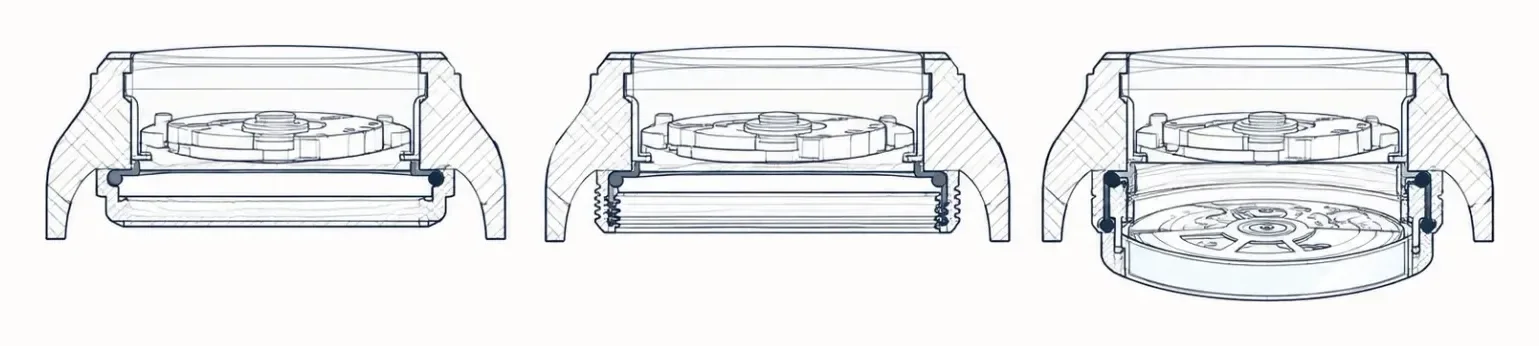
| Type | How it attaches | Typical use |
|---|---|---|
| Snap-on | Pressed into a groove | Dress, fashion, low-cost quartz |
| Screw-down | Threaded against a gasket | Dive, sport, high water resistance |
| Exhibition (display) | Screw-down with a window | Automatics, showing the movement |
| Screwed (bolted) | Fastened with small screws | Design statement, cushion cases |
Snap-on
A snap-on back is pressed into a machined groove and held by friction against its gasket. It is the cheapest to produce, the slimmest, and the fastest to open for a battery change — one reason it dominates fashion quartz. The limits are structural: friction seats the gasket less evenly than threads do, and every opening slightly relaxes the fit. A snap back done well is perfectly reliable at everyday splash ratings; it is simply the wrong part for a swimmer’s watch.
Screw-down
A screw-down back threads into the case body and compresses its gasket evenly around the full circumference. That even compression is the whole story of its superiority: the seal does not depend on how squarely the back was pressed in, and it re-seats identically every time it is serviced. The machined notches or flats around its edge are not decoration — they are the grip for the opening tool. Any watch aiming above 10 ATM starts here.
Exhibition
An exhibition back is a screw-down back with a sapphire or mineral-glass window set into it, trading a little sealing simplicity for a view of the movement. It earns its place on automatics with a decorated rotor or an open-worked caliber — and it is wasted money over a plain quartz module. The window adds one more gasketed joint and one more component cost; sapphire windows resist scratching far better than mineral and are the right choice if the watch will sit caseback-up on a desk five nights a week.
The outliers
Two rarer constructions complete the picture. A bolted back is fastened with four to six small screws into threaded holes — visually industrial, and sealing well when torqued evenly, but slower to service. A monobloc case has no back at all: the movement loads through the front after the crystal and bezel are removed. It is the most water-tight architecture possible and the most awkward to service, which is why it stays rare outside specialist dive pieces.
§ 03Sealing and water resistance
Every caseback seals against a rubber gasket (an O-ring). The attachment method decides how evenly and how hard that gasket is compressed, which is what actually keeps water out.
| Caseback | Practical WR ceiling | Why |
|---|---|---|
| Snap-on | Up to ~5 ATM | Friction fit; uneven gasket pressure |
| Screw-down | 10–30 ATM | Threads compress the gasket evenly |
| Exhibition | 3–10 ATM | Extra crystal joint to seal |
Water resistance is a system, not a single part — the crown and crystal seals matter too — but the caseback sets the ceiling. You cannot build a 20 ATM dive watch on a snap-on back.
Gaskets: the part nobody sees
The gasket itself is a few cents of nitrile rubber (NBR) or, on better builds, fluoroelastomer (FKM/Viton), which shrugs off heat, sunscreen, and chlorine that harden nitrile over years. It lives compressed in a machined groove, lightly greased with silicone so it seats without twisting. Gaskets are consumables: they flatten and craze with age, which is why “water-resistant” is a statement about the watch as it left the pressure tester, not a permanent property.
The standards behind the numbers
The ATM ratings on a dial trace back to two ISO standards. ISO 22810 governs ordinary water-resistant watches — it defines the over-pressure test behind ratings like 5 ATM or 10 ATM. ISO 6425 governs true divers’ watches: 100 m minimum, tested at 125% of rated pressure, with condensation, thermal-shock, and salt-water requirements on top. On our line every assembled watch — not a sampling — goes through an air-pressure test, and dive-rated builds add wet testing to their full rating; both are part of our in-house testing process.
§ 04Engraving and branding
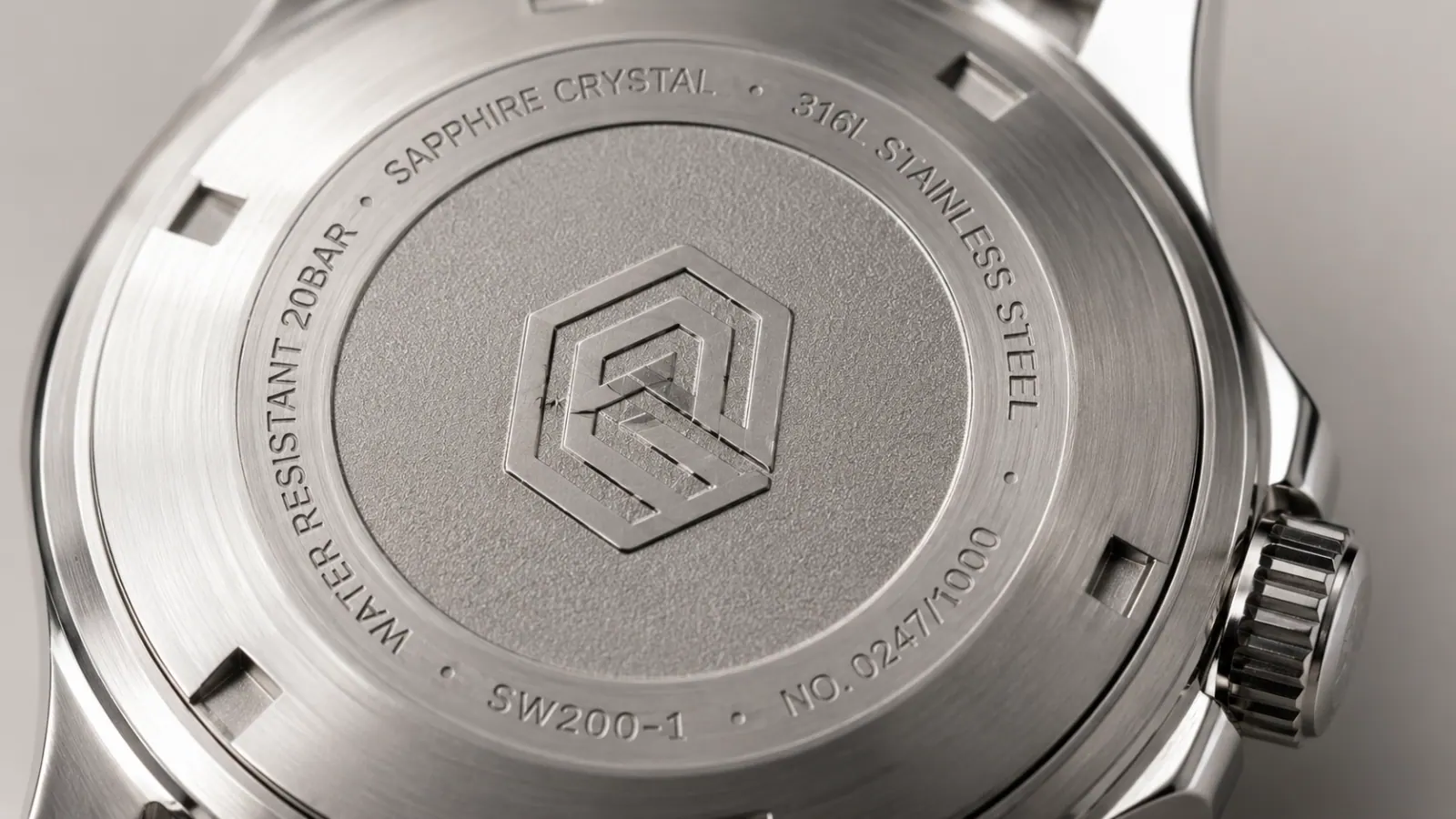
The caseback is prime real estate for branding because it is flat, hidden from daily wear, and cheap to mark. On a custom watch it typically carries the brand logo, the model name, a serial or limited-edition number, and standard marks such as the case material, water-resistance rating, and reference number.
| Method | Character | Best at |
|---|---|---|
| Laser engraving | Crisp line art, fine text | Any volume — no tooling |
| Stamping / embossing | Raised or recessed relief | Larger runs — needs a die |
| Deep etch + lacquer fill | Colored, tactile marks | Statement backs, editions |
Laser engraving is the workhorse: permanent, sharp down to very fine detail, and economical even at sample quantity because there is no tooling — the artwork goes straight from your vector file to the machine. Stamping gives a three-dimensional relief that reads more traditional and more premium, but the die is a one-time cost that only makes sense spread across a real production run. Serial numbers deserve a special mention: engraving each unit with its own number costs almost nothing at production time and gives a young brand instant credibility and traceability — we recommend it on every private label run.
§ 05Opening and maintenance
Casebacks are opened to change a quartz battery, service a movement, or replace a gasket. The method depends on the type:
- Snap-on — pried open with a thin case knife at the lug notch. Quick, but easy to scratch without care, and the back must be pressed home square with a case press, not thumbs.
- Screw-down — unthreaded with a caseback wrench or a die that grips the notches around the edge. The wrong tool slips and leaves the crescent-shaped scars you see on badly serviced watches.
- Exhibition — same as screw-down, with extra care not to mark the display window.
Two habits separate a professional reseal from a hopeful one. First, the gasket is inspected every time the back comes off, re-greased with silicone, and replaced without hesitation if it is flattened or cracked — the part costs less than the coffee of the person fitting it. Second, the watch is pressure-tested after closing, because a reseal is a claim and a test is a fact.
A watch is only as water-resistant as its last reseal. If a watch has been opened at a mall kiosk for a battery change and never pressure-tested, treat its rating as decorative until proven otherwise.
§ 06Choosing a caseback for a build
Match the caseback to the watch’s purpose — it is a decision about water resistance, thickness, and where your brand story lives.
| If the build is… | Use | Why |
|---|---|---|
| Dive / sport, 10 ATM+ | Solid screw-down | Highest, most repeatable seal |
| Automatic with a decorated movement | Exhibition (sapphire) | The movement is the selling point |
| Slim dress or value quartz | Snap-on | Saves thickness and cost at 3–5 ATM |
| Industrial / design-led statement | Bolted | The hardware is the aesthetic |
Cost-wise the differences are modest per unit — the caseback is not where a budget is won or lost, as the breakdown in our OEM cost guide shows. What the choice really buys is the rating you can print on the dial and the way the watch feels when a customer turns it over.
On a custom run we will recommend the back that fits your water-resistance target and budget, then handle the engraving or display window in the same build. Send your specs and we will quote it within 24 hours.