
§ 01Why finishing matters
Two watches can share the same case shape, the same 316L steel, and the same movement — and feel completely different in the hand. The difference is finishing: how the surface of the metal is treated after it is cut. Finishing sets how a case catches light, how premium it reads, and how well it hides the scratches of daily wear.
Finishing is also where factories quietly differ most. Machining a case shape is a solved problem; putting an even satin grain on a curved lug, or a crisp polished bevel between two brushed planes, is hand-guided work that separates a clean build from a cheap one. It is the first thing we look at when a client brings us a competitor’s sample to beat.
§ 02Polished
Polishing buffs the metal against progressively finer compounds until the surface reflects like a mirror. It is the dressiest finish — bright, reflective, and formal.
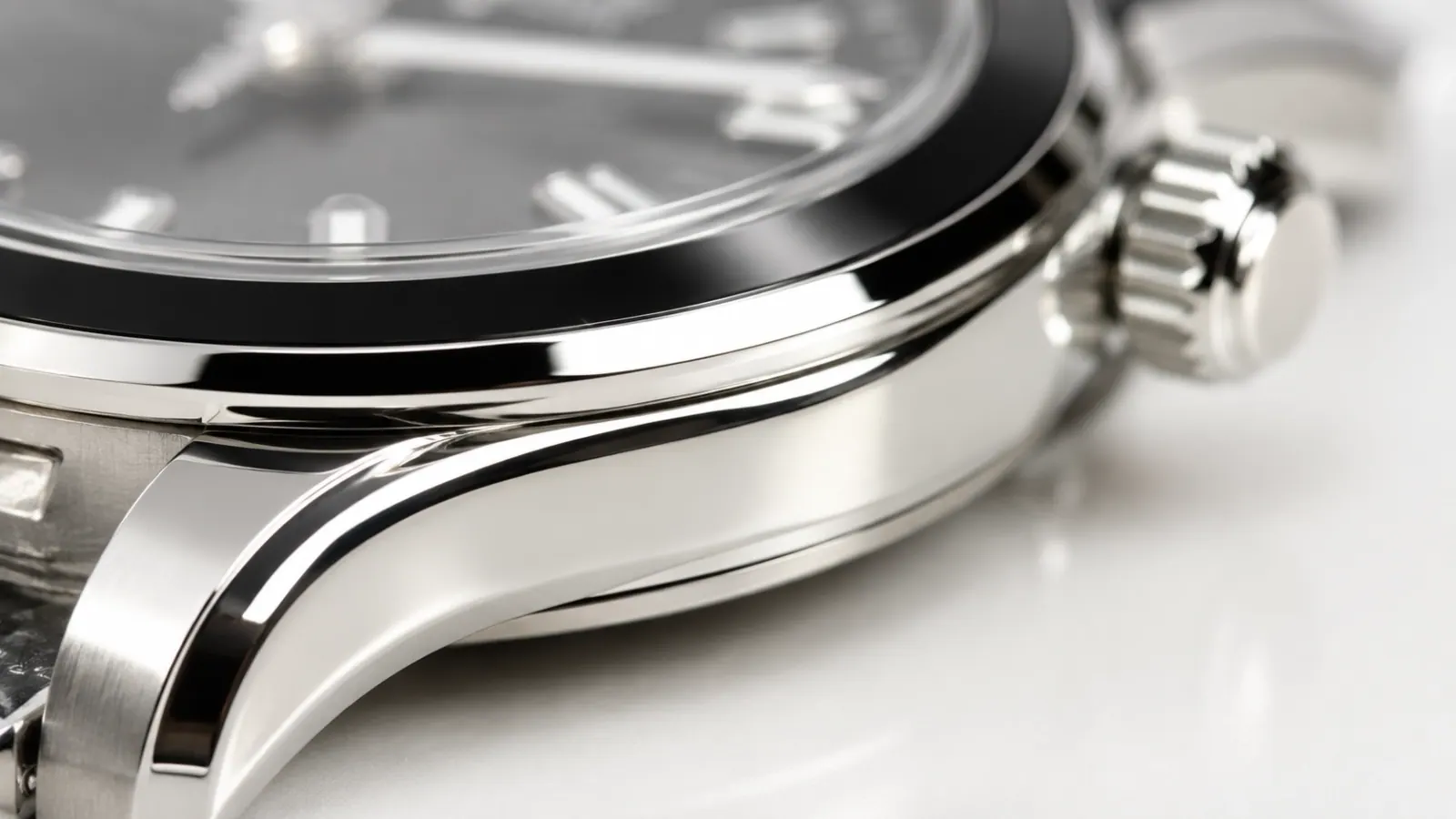
How it is done on the floor
A polished case is not one operation but a sequence: the machined blank is sanded through finer and finer grits to erase tool marks, then buffed on cloth wheels charged with cutting and finishing compounds until the surface is optically flat. Every stage removes a little metal. That is the hidden constraint of polish — over-buffing rounds off the crisp edges and softens the case lines, which is exactly what you see on badly refinished second-hand watches. A factory that polishes well is really a factory that knows when to stop.
The trade-off is durability. A mirror surface shows every hairline scratch and swirl, so polished cases look their best on dress watches that lead a gentle life. Polishing can be restored, but each pass removes a little more metal and softens sharp edges further.
§ 03Brushed / satin
Brushing drags a fine abrasive across the metal in one direction, leaving parallel satin lines. The surface scatters light instead of reflecting it, giving a muted, technical, “engineered” look. It is the workhorse finish of sport and tool watches because it hides scuffs well and is easy to restore with a single directional pass.
| Grain | Look | Common on |
|---|---|---|
| Fine satin | Smooth, soft sheen | Bracelets, case tops |
| Coarse brushed | Visible directional lines | Tool and field cases |
| Circular (perlage) | Overlapping swirls | Movements, special editions |
Grain direction is a spec, not an accident
On a well-made case the grain has a plan: lengthwise along the lugs, radial around a bezel, across the bracelet links. Grain direction is written on our production drawings surface by surface, because a lug brushed the wrong way jumps out to any trained eye — and because a consistent grain is what makes later scratch-repair invisible. When you send us a reference watch to match, grain direction is one of the first things we document.
§ 04Sandblasted / matte
Sandblasting (bead blasting) fires fine media at the case to leave a uniform, non-directional matte texture. There is no grain and no reflection — just an even, stealthy surface. It hides wear better than any uncoated finish because there is no mirror or grain for scratches to interrupt, which makes it a favorite for military-style and stealth designs.
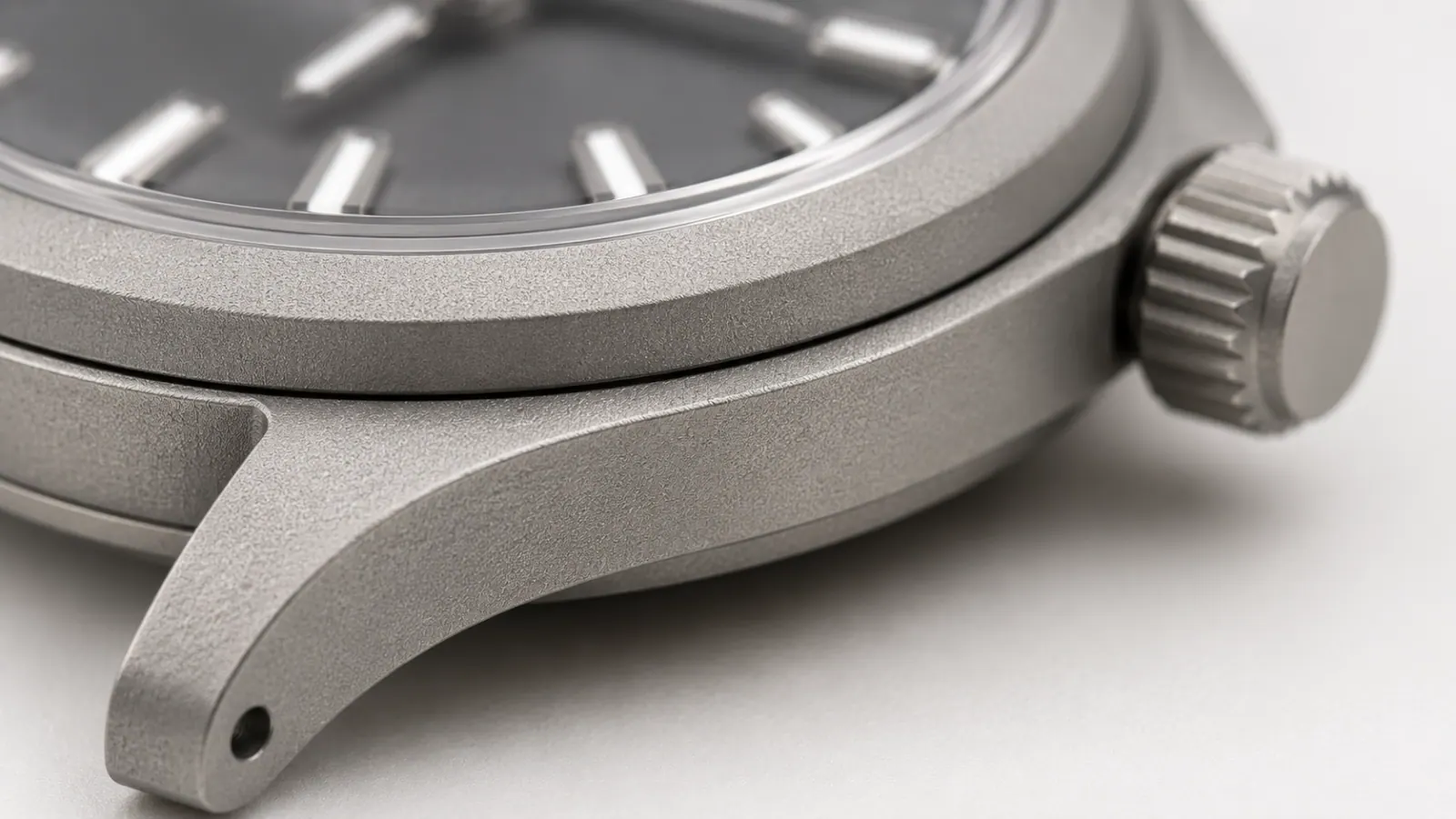
The media sets the texture
“Blasted” covers a family of textures set by what is fired at the metal. Glass bead gives the smooth, silky matte most people picture — soft to the touch, slightly warm in tone. Ceramic media cuts a flatter, more aggressive grey. Coarser sand produces the rough, industrial texture seen on some military reissues. The media, pressure, and distance are process parameters we lock during sampling, because two “sandblasted” cases from different setups can look surprisingly different side by side.
§ 05Coatings — PVD, DLC, plating
Coatings add color and hardness on top of the base finish. The metal is first polished, brushed, or blasted, then a layer is bonded to it — the coating faithfully reproduces the texture underneath, which is why a PVD case is specified as two decisions: base finish, then coating.
| Coating | What it is | Durability |
|---|---|---|
| PVD | Vapor-deposited ceramic-like layer, ~1–3 µm | High — bonds to the steel |
| DLC | Diamond-like carbon, deep matte black | Very high — hardest coating |
| Electroplating | Gold or rose-gold plated layer | Lower — wears at edges over time |
What the hardness numbers mean
Bare 316L steel measures around 200 on the Vickers hardness scale — a key opens it. A PVD nitride layer typically lands well above 1,000 HV, and DLC harder still; in daily wear that is the difference between a case that collects hairlines and one that shrugs off keys and desk edges for years. The coating is thin — a few microns — so it changes nothing about the case dimensions, but it is only as strong as the surface preparation beneath it, which is why coated runs get an extra cleaning and inspection stage before the chamber.
Process and cost realities
PVD happens in a vacuum chamber: the cases are racked, the chamber pumped down, and metal vapor deposited over several hours. Because a chamber runs as a batch, coated builds are quoted per batch — small MOQs share chamber space, and color changes (black, gunmetal, bronze, blue) are a racking decision rather than a tooling one. Traditional gold electroplating remains the budget route to a gold look and the warmest in tone, but the layer is soft and wears through at high-contact edges over years, so we steer tool-watch builds toward PVD and keep plating for dress pieces. Where each option lands in a real budget is itemized in our OEM cost guide.
One more variable sits under the coating: the case alloy itself. The finishing and coating story is the same on 316L steel and on cheaper alloys, but the wear story is not — see alloy vs stainless steel watches for that comparison.
§ 06Combining finishes on a custom case
The most expensive-looking cases are not the most polished — they are the most deliberately contrasted. Pairing a brushed case top with polished bevels, or a blasted case with a polished bezel, creates crisp transition lines that read as high craftsmanship and catch light from different angles.
In practice the finishing plan is a surface-by-surface table on the production drawing: case top brushed lengthwise, flanks polished, bezel polished, caseback blasted, crown polished with a brushed band. The hard part — and the part worth paying a real factory for — is the transition: a polished bevel is only impressive if the line where it meets the brushed plane stays razor straight along the whole lug. That edge is protected by masking during finishing and checked under magnification at cosmetic QC, because it is the single most visible tell of build quality on the entire case.
§ 07Choosing a finish for your brand
The finishing plan should follow the positioning of the watch, not taste alone:
| Positioning | Finish plan | Why it works |
|---|---|---|
| Dress / classic | Full polish, or polish + fine satin top | Formal light play; gentle life |
| Sport / tool | Brushed body, polished bevels | Hides wear; contrast reads premium |
| Military / stealth | Full blast, or blast + DLC | Zero reflection; best wear resistance |
| Fashion / gold look | Polish + PVD or plating | Color range at controlled cost |
Two practical notes from the production side. First, finishing choices barely move the per-unit price between brushed, polished, and blasted — the cost driver is coating, not base finish — so choose the base finish on design grounds. Second, always judge the finish on a physical sample, in daylight, before the run: renders flatter every finish equally, and the difference between a fine and coarse satin simply does not survive a screen.
On a custom build you choose the base finish per surface and the coating on top. Send a reference or a sketch and we will map the finishing plan — and quote it — within 24 hours.